
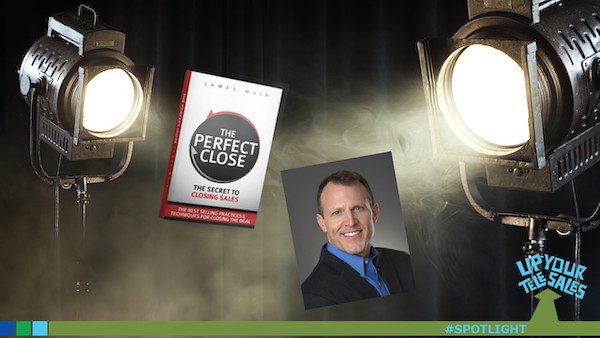
I LOVE a good workbook. Okay, it’s true – I like books in general… yet there is something about a workbook that, well, makes me want to get to work!
Filling in the exercises and developing how I will use the content of someone’s book… that makes me excited to try the new things I’m learning.
In fact, that is how James Muir starts off his introduction:
“One challenge to learning is the ability to translate general concepts into your own specific situations.” (pg vi)
James Muir’s book and accompanying workbook The Perfect Close describe three things:
- Close – a firm commitment to buy. It is the consummation of the sale and the final order that marks the transition from evaluating to ownership and actual use of the product or solution.
- Advance – a significant action that requires energy by the client – either in the call or right after it – that moves the sale toward a decision.
- Continuation – a situation where the sale will continue, yet no specific action has been agreed upon by the customer to move forward.
In my own practice, I teach inside salespeople that issues with closing a sale often boil down to qualifications issues. Therefore, my favorite parts of both the book and workbook deal with “The Critical Advance” (book Chapter 5 and workbook Chapter 6).
When inside salespeople tell me they had a successful call, I ask: “WHAT did the prospect or customer actually COMMIT to doing AFTER the call.”
If the answer is “NOTHING” when I ask about “WHAT” – “COMMIT” – or “AFTER”… then NOTHING will happen after the call, no matter how good we feel about it.
Although the prospect or customer was nice… pleasant… even interested, if they didn’t actually COMMIT to do anything, James (and I) would tell you that is a continuation.
One takeaway from the workbook that I had not considered before is: Ranking the strength of an advance with 1 being weakest and 5 being the strongest. This approach engaged my brain in a new way, and I think better with a pen in my hand anyway.
So, I started thinking about advances and doing the math on how they rank.
Here are some of my ideas:
- Continuation: The prospect says “it’s interesting” and “will be in touch when they have a need.”
- Advance (Weakest): Prospect agrees to talk again about a specific pain point and potential solution.
- Advance (Middle): Prospect accepts a meeting request.
- Advance (Strong): Prospect suggests – and then does – gather their team together for a demo/presentation/etc.
- Advance (Strongest): Prospect proceeds to evaluation stage to test proof of concept.
Specifically, for inside salespeople, we need to know the right next step to ask for next BASED ON OUR CONVERSATION. Occasionally we get lucky and ask for the best advance off the top of our head. Most of the time, however, it takes practicing our if-then scenarios to become really smooth at this important and critical success skill.
Not shockingly, that is the topic in Chapter 7 of the workbook…
“By setting appropriate call objectives for each encounter, we will achieve an unbroken chain of successful advances that will ultimately lead to closing the sale and getting the order.” (workbook page 49)
That is probably why, for me, working through the pages of a workbook helps me take concepts and put them into practice. As I do an exercise, it gets my brain thinking, and I naturally begin to apply the lessons that resonate with me.
Keep working,
Lynn
PS: Knowing that everyone likes bonus gifts, James Muir has generously offered A Chip off the Block readers his audio book for free when you purchase the workbook from Amazon. Simply email your Amazon receipt directly to James (yup, to him directly!) at jmuir@puremuir.com – After you work through it, let me know what lessons rang true for you.
Comments (0)