
Your pipeline may be the end of the story, not the place to start fixing it.
Before you start searching through your tech stack to figure out whether someone bought another platform without telling you, I’m talking about a Strategic Selling Intelligence System. It’s the disciplined, evidence-based process your inside salespeople use to move from identifying an account worth pursuing all the way through deciding whether an opportunity actually deserves continued time and attention in the pipeline.
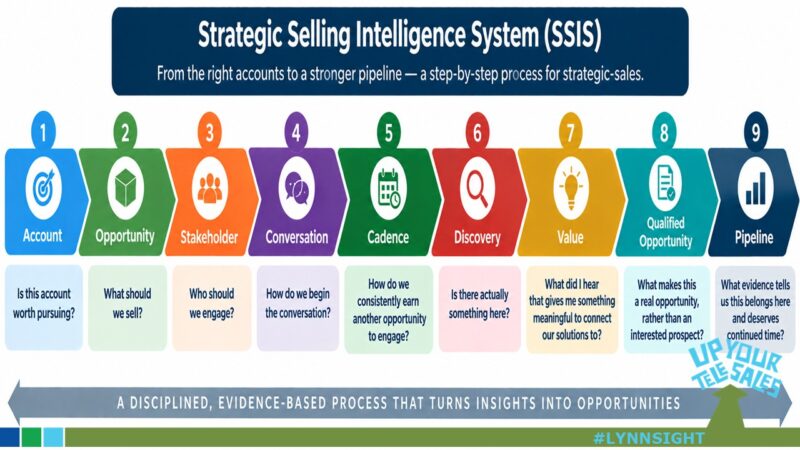
Take a look at the graphic. There are nine steps: Account → Opportunity → Stakeholder → Conversation → Cadence → Discovery → Value → Qualified Opportunity → Pipeline.
At first glance, you might look at that and say, “Lynn, isn’t that just selling?”
Well… yes. And no.
What interests me isn’t whether your salespeople perform each of these activities. I want to know whether there is intelligence connecting them. Because doing the activities is one thing. Understanding why you’re doing them, what you’ve learned from them, and whether that evidence justifies taking the next step is something very different.
Your Pipeline Problem Doesn’t Start as a Pipeline Problem
Inside sales leaders spend a lot of time looking at pipeline. We want to know how much is there, what’s moving, what’s stalled, what’s going to close, and what slipped. Then there’s my personal favorite: Is that really going to close this month?
Pipeline gets all that attention because it’s close to the result we care about. Yet by the time something shows up in your pipeline, your salesperson has already made a whole series of decisions that determined whether it belonged there in the first place.
They decided an account was worth pursuing and identified an opportunity they believed might exist. They selected a stakeholder to engage and found a way to begin a conversation. Then they created some kind of cadence to earn another conversation, conducted discovery, heard something they interpreted as value, and decided there was a qualified opportunity worthy of putting into the pipeline.
That’s a lot of decisions made before you ever see that opportunity in a forecast.
Which means when you have a pipeline problem, looking only at the pipeline may mean you’re looking at the last puzzle piece instead of the whole picture.
Activity Isn’t Intelligence
Inside sales organizations love activity. Calls, emails, connections, meetings, opportunities created, pipeline generated; all of those can be useful measurements. What they don’t tell you is whether your salesperson is making good decisions along the way.
That’s where the questions underneath SSIS become more important than the labels themselves.
Why this account? What opportunity do we believe exists? Why this stakeholder? What did we learn from the conversation? Why would they want to talk with us again? What did discovery actually uncover? Where is the value? What makes this a qualified opportunity rather than an interested prospect?
And eventually: What evidence tells us this deserves continued time?
That last word matters.
Evidence.
Your pipeline isn’t supposed to be a collection of your salespeople’s hopes, wishes, and good feelings about conversations. It should be the outcome of what they’ve learned.
Structure Gives Salespeople Room to Think
In Mastering Inside Sales Leadership, I talk about planning as an advantage precisely because inside sales doesn’t operate in a predictable environment. Teams change. Territories shift. Products are launched or canned. Leadership direction changes. Customers certainly don’t follow the plan we created for them.
That uncertainty isn’t a reason to avoid structure. It’s the reason we need it. As I say in the book, “A plan gives you the structure to adjust instead of scramble.” Mastering Inside Sales Leadersh…
I believe strategic selling works the same way.
An SSIS isn’t designed to remove judgment from selling. It’s designed to improve judgment. Instead of giving salespeople another checklist of things they’re supposed to do, we’re giving them a series of questions that help them think about what deserves to happen next.
For inside sales leaders, that gives us something important as well: a common language for coaching.
Instead of asking, “Why isn’t this moving?” we can go backward and look for where the intelligence became fuzzy. Did we pursue the wrong account? Assume there was an opportunity before we had evidence? Engage someone who couldn’t help us move forward? Mistake a pleasant conversation for discovery? Hear interest and interpret it as value?
Suddenly, pipeline coaching becomes less about pushing the salesperson to move something forward and more about helping them figure out whether it should move forward.
There’s a big difference.
Three Parts of the Intelligence System
Over the next three posts, I’m going to break the nine elements of SSIS into three groups because I believe each group answers a fundamentally different strategic selling question.
We’ll start with Account / Opportunity / Stakeholder. Before anyone picks up the phone, sends an email, or starts crafting the perfect LinkedIn message, are we pursuing an account that’s worth our time? What should we be selling there? And who should we be engaging?
Then we’ll move into Conversation / Cadence / Discovery. Getting someone to respond isn’t the goal. We need to know how to begin a relevant conversation, how to consistently earn another opportunity to engage, and eventually whether there is actually something worth pursuing.
Finally, we’ll look at Value / Qualified Opportunity / Pipeline. This is where the evidence has to become strong enough to justify continued investment. What did we hear that gives us something meaningful to connect our solutions to? What makes this a real opportunity rather than an interested prospect? And what evidence tells us it deserves continued time?
Notice the progression. We’re moving from where we choose to spend our time, through what we learn when we engage, to whether the evidence earns more of our time.
That’s strategic selling intelligence.
LYNNSIGHT®: Start Before the Pipeline
Before we get into Account / Opportunity / Stakeholder, try something with your team.
Pull up your pipeline and choose three opportunities. Resist the temptation to begin with the questions you usually ask. Don’t start with When is it going to close? What’s the next step? How much is it worth?
Instead, go all the way back to the beginning and ask:
- Why this account?
- Why this stakeholder?
- What opportunity did you identify?
Then listen for the evidence behind their answers and the intelligence that connects one decision to the next.
A stronger pipeline starts by becoming more disciplined about which opportunities deserve to get there.