
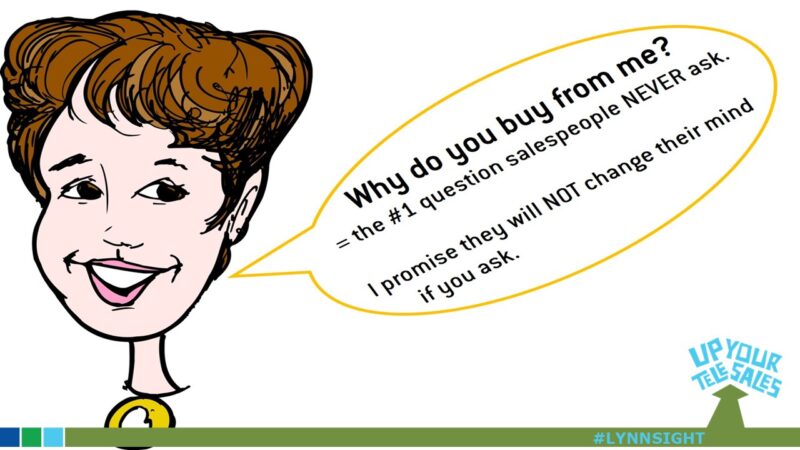
I’ve asked a lot of salespeople why their customers buy from them, and I can almost predict the answers. “We have great service.” “Our quality is better.” “I’m really responsive.” “We’ve built a great relationship.”
Maybe all of that is true. But there’s one little problem: those are your answers.
Have you ever actually asked your customers?
Every salesperson does something unique for their customers, yet you may be the LAST person to recognize what your something is.
That’s because whatever makes you valuable probably doesn’t feel particularly remarkable to you. You just do it.
- Perhaps you remember little details about your customers’ businesses that other salespeople forget.
- Maybe you ask questions that make people stop and think differently.
- You might have an uncanny ability to translate all the technical mumbo jumbo into something that makes sense.
- Or perhaps your customers know that when something goes sideways, you’re going to tell them the truth instead of telling them what they want to hear.
To you, that’s simply how you sell. To your customers, it may be the reason they buy from you.
Which is why I think one of the most important questions a salesperson can ask is also one of the questions salespeople almost NEVER ask:
“Why do you buy from me?”
Notice I didn’t say, “Why do you buy from my company?” That’s a different question. Your company may have fantastic products, competitive pricing, great technology, strong delivery, or a brand people trust. I want to know why that customer buys from YOU.
That question can feel a little uncomfortable. We tend to believe we already know the answer, and perhaps there’s also a tiny voice wondering what will happen if we ask. Will the customer suddenly reconsider the relationship? Will they realize there’s no good reason to keep buying from us?
I promise they will NOT change their mind because you ask.
They already know why they buy from you. You’re the one who doesn’t know.
Imagine a salesperson who is convinced her longtime customer buys from her because she’s incredibly responsive (true story). She returns calls quickly, answers emails, jumps on problems, and gets quotes out the door. She sees responsiveness as the thing that separates her from everyone else trying to win that customer’s business.
Then she asks, “Why do you buy from me?”
The customer doesn’t say responsiveness at all. Instead, they tell her they value that she understands their business well enough to tell them when not to buy something.
Think about the difference between those two answers. The salesperson believes her value is speed. The customer believes her value is judgment.
If she never asks, she’ll keep working hard to be faster. She’ll answer emails sooner, return calls faster, and get quotes out immediately. Those are all good things, of course, but they aren’t necessarily the thing creating loyalty.
Once she knows the customer values her judgment, she can be much more intentional about strengthening what actually matters. She can keep learning about the customer’s business, ask better questions, understand what they’re trying to accomplish, and have enough confidence to say, “You know what? I don’t think you need that” when it’s in their best interest.
Now she’s beginning to understand her value.
One customer’s answer, though, is only the beginning. My recommendation is ask multiple customers and capture what they tell you without trying to edit, categorize, or turn their answers into fancy sales language. That part is important because salespeople have a habit of translating perfectly good customer language into something that sounds like it came from a corporate brochure.
If your customer says, “You make complicated stuff easy for me to understand,” please don’t turn that into “consultative communication expertise.” Write down what they actually said.
Then ask another customer. And another. Ask different people inside an account as well. As you listen, you may begin to hear echoes. The exact words will be different, and the situations may have nothing in common, but underneath those answers you may discover a theme.
Whatever you discover, that is your customer telling you what your personal value looks like from their side of the relationship.
And that’s when this becomes much more than a feel-good customer conversation. Once you understand why existing customers buy from you, you can start looking for prospects who would value those same things.
- If customers value your ability to make complicated decisions feel simple, who else is struggling with complexity?
- If they appreciate that you spot problems before they become emergencies, who else is tired of being surprised?
- If they trust you because you’re willing to tell them when not to buy, who else is looking for someone they can trust instead of another salesperson trying to sell them something?
Suddenly your prospecting conversation changes. You’re no longer trying to convince everyone that you’re valuable. You’re looking for people who need the value you already bring.
That’s a very different way to think about selling.
So the next time you’re talking with a customer who buys from you regularly, try asking the question.
“Why do you buy from me?”
Then be quiet long enough to hear the answer. Listen to their words and, when the conversation is over, write them down.
Then do it again with another customer.
Eventually, you may discover something about yourself as a salesperson that your customers have known all along.
After all, you really can’t spell value without YOU.