
You start Monday with the best of intentions.
You know what the team is supposed to be building. You’ve got both long-term goals and a focus area for the month that is going to get you there.
Maybe the focus is account expansion. Maybe it is better qualification. Maybe it is forecast accuracy, because the last forecast meeting had a little too much creative writing.
Then the week starts acting like the week.
- 8:47, a rep has messaged you about a deal that was “definitely closing” and is now developing a personality.
- 9:15, someone wants to know whether the team will still hit the month.
- 10:30, a customer issue has moved from “minor concern” to “apparently everyone has feelings.”
Somewhere in there, you glance at the focus area you were going to work on this week and think, “Right. That.”
That is the part inside sales leaders live with every day. The long-term work is important, but the urgent work seems to interrupt… escalate. It brings receipts. The twelve-month plan, on the other hand, is polite. It waits quietly in the corner while the month-end number clears its throat.
If you are not careful, that polite important work disappears.
Not all at once. It disappears in reasonable-sounding pieces. You will get back to account expansion after month-end. You will revisit qualification next week. You will tighten forecasting once this messy deal closes. You will restart the coaching rhythm when things calm down.
Which is adorable, because things rarely calm down in inside sales. They just change into different urgent costumes.
The mistake is believing you have to choose between this month and the next twelve months.
You do not. You do, however, have to stop pretending they deserve the same amount of attention every week.
They don’t.
Some weeks are heavy urgency weeks. Closing the month matters. Customer commitments matter. Late-stage risk matters. If the number is light and the forecast is wobbling, you cannot float above it muttering about strategy. You have to lead what is in front of you.
Leading what is in front of you does not mean dropping everything else.
It means shrinking the important work until it fits the week you are actually in.
Many leaders look at the twelve-month focus and think, “I don’t have time for that right now.” And they may be right, if “that” means the full version. A complete territory review. A full skill session. A deep account-planning process. A clean CRM adoption push. Fine. Maybe this is not the week for the full version.
But there is almost always room for the smallest useful version.
If your long-term focus is forecast accuracy, and this is a chaotic close-the-month week, you do not need to inspect every opportunity in the pipeline. Start with the deals that are supposed to close this month. Ask for value, confidence, and timeframe. That keeps the forecasting habit alive while still serving the urgent need.
If your long-term focus is account expansion, you do not need every rep to build a polished account plan by Friday. Ask each person to identify one current customer with a realistic expansion opportunity for next quarter. One. That is not a strategic overhaul. That is keeping the thread in your hand.
If your long-term focus is stronger qualification, you do not need to run a full retraining session between forecast calls and customer escalations. In every deal conversation this week, ask one better question: “What still has to happen before this can close?”
That question takes ten seconds.
It also refuses to let the important work vanish. Notice an important theme? ONE.
This is what juggling urgency and importance really looks like. It is not a perfect 50/50 balance. It is not a color-coded time-blocking fantasy where no one interrupts you and all meetings end early (oh, the dream). If you have found that place, please send directions.
In the real world, it’s not about balance.
Some weeks, urgency gets 80 percent of your attention. Some weeks it gets 40. The percentage is not the problem. The problem is when importance gets zero.
Zero teaches the team something.
It teaches them that the focus area only matters when the calendar is quiet. It teaches them to wait and see whether this week’s priority survives contact with pressure. It teaches them that the real plan is whatever happens to be loudest.
Then, a few weeks later, the leader says, “Why aren’t we making progress on this?”
The team may not say it out loud, but the answer is sitting right there: because the target kept disappearing.
Salespeople watch what leaders protect. They listen to what gets repeated. They notice which behaviors stay important when the month gets uncomfortable.
That is why the leader has to make the tradeoff visible.
“This is a close-the-month week, so most of our attention is on late-stage deals and forecast risk. We are keeping our twelve-month focus alive by updating value, confidence, and timeframe on every deal expected to close this month.”
Now the team knows what is urgent.
They also know what is still important.
Cadence is not giving every priority equal attention. It is keeping the right priority alive in the size the week can handle.
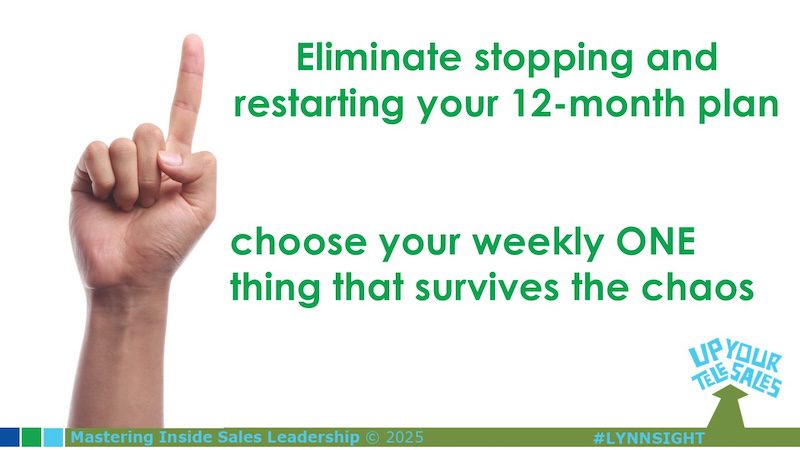
Eliminate stopping and restarting your 12-month plan.
You do not wait for the perfect week to work on the twelve-month focus. You keep a small piece of it alive during the messy weeks, then expand it when the pressure eases.
The leader controls that balance.
The salesperson controls the behavior inside it.
So before the week runs away with the plan, decide what version of the important work survives. The useful version.
- The one behavior.
- The one question.
- The one account.
- The one forecast habit.
That is how the twelve-month plan keeps breathing while this month is busy making noise.