
Sometimes, inside sales leaders have to ask questions that salespeople don’t enjoy answering.
Why hasn’t that opportunity moved? What happened to the prospecting commitment? Why are activity numbers down? What’s preventing you from having the conversations you need to have?
Those are legitimate things to explore, yet the way we ask can influence how much useful information we actually get.
Think about the difference between a salesperson hearing
- “Why didn’t you make those calls?”
- vs. “I’m trying to understand what happened with the prospecting commitment we discussed. Walk me through your week.”
Both questions address the same concern, but the second gives the salesperson a little more room to explain without immediately feeling as though they need to defend themselves.
Making a Question Easier to Hear
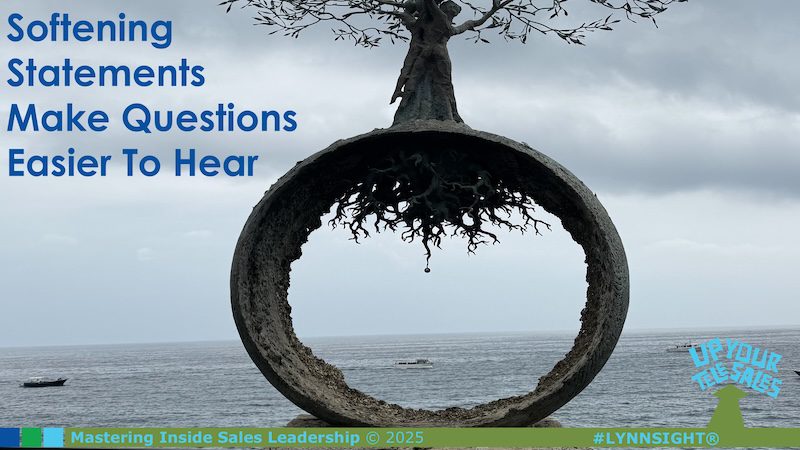
In the third part of my Communication Trilogy, I talk about softening statements. They’re short phrases that help someone receive a question without immediately feeling challenged or defensive.
Things like:
- “Let me see if I’ve got this straight…”
- “I was wondering…”
- “I’d appreciate it if you would share…”
- “I’m confused…”
- “Let me ask you this…”
These aren’t magic words, and they certainly don’t guarantee someone will give you a straightforward answer. They can, however, change how a conversation begins, particularly when the subject is sensitive, or the salesperson is already frustrated.
They’re also useful when you’ve had the same conversation more than once, and you’re beginning to feel frustrated yourself. That’s often when our questions become sharper, even when we don’t intend them to.
Accountability Still Matters
I want to be clear that softening a question doesn’t mean softening the expectation.
If a salesperson committed to making 40 calls and made 12, you still need to understand what happened. And if someone repeatedly misses agreed-upon next steps, you need to address the pattern rather than allowing another conversation to end without a meaningful commitment.
The difference is in how you approach understanding the gap.
Perhaps there’s a legitimate obstacle preventing the salesperson from doing what you’ve asked. Maybe they don’t understand the expectation as clearly as you thought they did, or they haven’t developed the skills to execute it successfully. It’s also possible that you’re dealing with someone who understands the expectation and has simply chosen not to follow through.
Those situations require different leadership responses, which is why I keep coming back to the importance of diagnosing before reacting.
You’re much more likely to understand what’s happening when the salesperson feels able to explain rather than immediately needing to defend their actions.
Pay Attention to Your Opening
Think about a coaching conversation you’ve been putting off because you expect the salesperson to become defensive. You probably already know what you need to ask, and you may even have a pretty good idea of what they’re going to say.
Before you have that conversation, consider how you plan to introduce the question. Is there a way to make it easier for the salesperson to hear what you’re asking without suggesting that the expectation has changed?
You don’t need to avoid difficult questions to maintain a productive coaching relationship. You do need to ask them in a way that gives you the information necessary to decide what happens next.
This week’s Leadership LYNNSIGHT: Before your next difficult coaching conversation, write down the question you need answered and consider whether a softening statement would help your salesperson hear it and respond thoughtfully.
The expectation can remain firm while the conversation becomes more productive.