
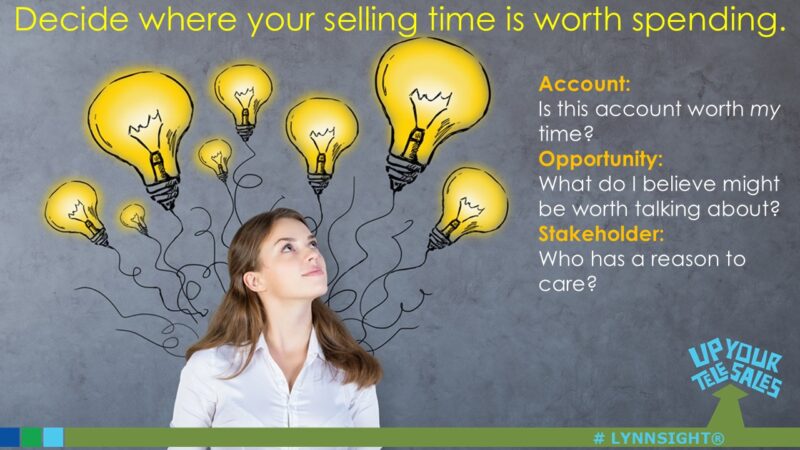
Account / Opportunity / Stakeholder
You have more places you could spend your selling time than you have time available. There will always be another account to research, another person to find on LinkedIn, another contact to add to a cadence, another email to write, and another call to make.
Which is why, sometimes, deciding what deserves your time is the problem.
That’s where the first three elements of your Strategic Selling Intelligence System (SSIS) come in: Account, Opportunity, and Stakeholder. Before you worry about what you’re going to say or how many times you’re going to reach out, make three decisions:
- Is this account worth my time?
- What do I believe might be worth talking about?
- Who has a reason to care?
You don’t need to know everything before you start selling. You need enough intelligence to have a hypothesis worth testing.
Account: Is This Account Worth My Time?
There are probably lots of accounts you can prospect. That doesn’t mean they all deserve the same amount of your attention.
Look for a reason this account is worth pursuing. Maybe something has changed in the organization, they’re growing, they’ve announced a new initiative, or they look a lot like customers you’ve been successful with before. There may be something happening in their industry or business that connects to a problem your company solves.
You aren’t trying to learn everything about the company. Please don’t turn “account research” into a way to avoid actually selling.
You’re looking for enough information to answer a simple question: Why am I choosing to spend my time here? If you have a reason, keep going.
Opportunity: What Might Be Worth Talking About?
Now resist the urge to jump straight to your product.
“They could use what we sell” isn’t an opportunity. You probably think everybody could use what you sell. That’s one of the charming things about salespeople.
Instead, use what you’ve learned about the account to develop a hypothesis about something that might be worth discussing. Is there a problem you may be able to solve, an outcome you could help them achieve, or a change they might be navigating?
The words might and may matter here because you don’t know yet.
You’re not trying to diagnose the customer from the outside. You’re giving yourself a reason to have a conversation.
There’s a big difference between approaching someone thinking, I know what you need and I’m going to tell you about it, and thinking, I see something that makes me curious about whether this is important to you.
Stakeholder: Who Has a Reason to Care?
Once you know why the account deserves your time and what might be worth discussing, choosing a stakeholder gets easier.
Don’t automatically search for the biggest title you can find.
Ask yourself, Who has a reason to care about this?
It might be someone experiencing the problem, someone accountable for the outcome, or someone who understands enough about the situation to help you learn whether your hypothesis is right.
Connect all three decisions: I’m pursuing this account because ____. Based on what I know, I believe there may be an opportunity around ____. That gives this person a reason to care because ____.
Now it’s time to start selling.
LYNNSIGHT®: Enough Intelligence to Begin
Here’s the part I don’t want you to miss: you don’t have to be right.
You may start the conversation and discover your opportunity hypothesis is completely wrong. The stakeholder you chose may tell you someone else owns it. You may even learn that the account isn’t worth another minute of your selling time.
Take that intelligence and use it to decide what to do next.
That’s what SSIS is about. It isn’t doing endless research until you’re certain you have the perfect account, opportunity, and stakeholder. It’s having enough intelligence to begin, then allowing what you learn to make your next decision better.
Your selling time is finite.
Decide where it’s worth spending and then go find out if you’re right.