
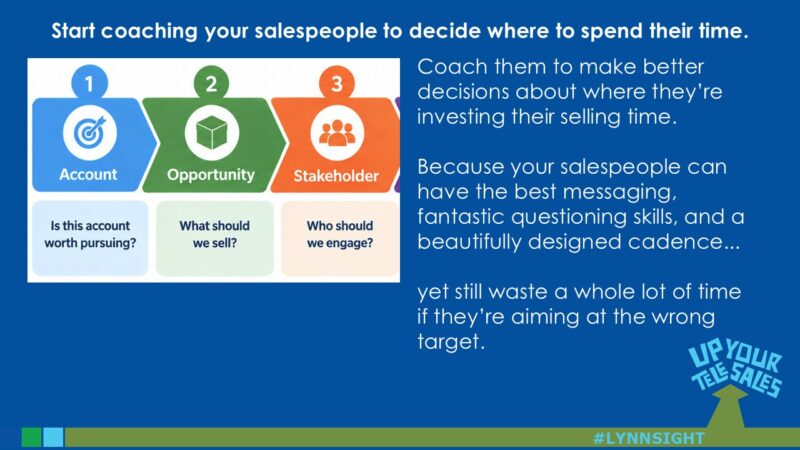
Account / Opportunity / Stakeholder
Your salespeople have more places they could spend their selling time than they have time available. Every salesperson has a territory, account list, prospect database, CRM, LinkedIn, inbound leads, old opportunities, referrals, and probably a few names written on sticky notes they swear they’re going to call someday. Finding something to do isn’t the problem. Deciding what deserves their time is.
That’s why the first three elements of the Strategic Selling Intelligence System are Account, Opportunity, and Stakeholder. Before your salespeople start worrying about what to say, which channel to use, or how many times to reach out, they need to make three decisions: Is this account worth pursuing? What should we sell? Who should we engage?
As their inside sales leader, your job isn’t to make those decisions for them. Your job is to coach them to get better at making those decisions themselves.
Start With the Account
When a salesperson tells you, “I’m prospecting into Acme,” your next question needs to be, “Why Acme?” You’re not trying to catch them without an answer; you’re trying to understand the thinking that caused them to decide this particular account deserves some of their finite selling time.
There are all sorts of reasons they may have selected it. Perhaps something has changed inside the organization or its market. Maybe the company has characteristics that look like your best customers. There may be a trigger event that caught their attention, or something about the business that suggests a problem you know how to solve. Of course, there’s also the possibility that Acme is on a list someone handed them and they started at the top.
That last one is activity. It isn’t strategic account selection.
I’m not suggesting your salespeople spend three hours researching every account before picking up the phone. In fact, please don’t let “I’m doing account research” become a clever way to avoid actually selling. What I want is for your salespeople to develop the ability to recognize the information that makes one account more worthy of their time than another.
That means your coaching isn’t about picking the account for them. It’s about helping them get better at explaining why they picked it.
Over time, something interesting happens. Your salespeople begin to recognize the signals that matter more quickly. They start seeing patterns between the accounts where they’ve been successful and the new ones they’re considering. Eventually, “Why this account?” becomes a question they ask themselves before you ever have to ask it.
That’s when you know the coaching is working.
An Account Isn’t an Opportunity
Once your salesperson has identified an account worth pursuing, it’s tempting to move immediately into execution. Who are we going to call? What are we going to say? Which cadence should we use?
The next decision is Opportunity: What should we sell?
I don’t mean which product they’d like to pitch. If your salesperson’s answer is, “I think Acme could use our XYZ solution,” you haven’t learned much. Of course they could use it. Your salesperson probably thinks everybody could use it. That’s one of the charming things about salespeople.
What you want to understand is why they believe there may be an opportunity for that solution inside this particular account. What did they learn about the business that connects to a problem you solve, an outcome you help create, a change you support, or something the organization may be trying to accomplish?
That changes the conversation from “Here’s what we sell” to “Here’s why I think there may be something worth talking about.”
Notice that I said may be.
At this point in SSIS, your salesperson doesn’t know if there is an opportunity. They haven’t earned the right to call it qualified, and they certainly don’t have enough information to start forecasting it. What they have is a hypothesis based on the intelligence they’ve gathered so far.
That’s exactly what you want.
Their job isn’t to magically know the answer before talking with anyone. Their job is to have enough of a reason to believe there is something worth investigating. The conversations and discovery that come later in SSIS will either strengthen that hypothesis, change it, or tell them there isn’t anything there after all.
As the leader, coach them to be curious enough to test their hypothesis rather than becoming so attached to it that they try to prove themselves right.
Now, Who Should We Engage?
Once there’s an account worth pursuing and a hypothesis about the opportunity, finding the stakeholder becomes much more strategic.
Unfortunately, this is another place where it’s easy for activity to get ahead of thinking. Your salesperson opens LinkedIn, searches for a title that sounds promising, finds a VP, and starts building a cadence. A few minutes later, that VP is receiving the same carefully crafted message as every other VP on the list.
Instead, coach your salesperson to connect the stakeholder decision to the first two decisions they’ve already made.
If this is the account we believe is worth pursuing, and this is the opportunity we believe may exist, who inside the organization is likely to care?
The answer may be the person who experiences the problem every day. It could be the person accountable for the outcome, someone who influences the decision, or a person with enough organizational knowledge to help your salesperson understand whether their hypothesis is even close to reality. Sometimes the person with the impressive title is exactly the right person. Sometimes they aren’t.
Your salesperson needs to be able to explain why they chose that stakeholder, and your job is to help them examine their reasoning.
That doesn’t mean turning every coaching conversation into an interrogation. It means being curious about their thinking. Ask what makes them believe this person will care, what role the stakeholder may play in the issue they’ve identified, and who else inside the organization might see the situation differently. You’re helping the salesperson build a picture of the account rather than simply collect contact information.
The Intelligence Is in the Connection
The real power of Account → Opportunity → Stakeholder isn’t in treating them as three boxes your salesperson needs to check before prospecting. The intelligence comes from connecting them.
Your salesperson should eventually be able to tell you a story that sounds something like this: We’re pursuing this account because of what we’ve learned about the business. Based on that information, we believe there may be an opportunity around this particular issue. Because that’s the issue we’re exploring, these are the people we believe are worth engaging.
Now you have something meaningful to coach.
You can challenge an assumption without taking over the decision. You can ask what evidence they’re using and what they still need to learn. You can help them see a gap in their thinking or recognize when they’re making a leap that the evidence doesn’t support.
Most importantly, you can help them decide whether the next action deserves their time.
That’s very different from coaching solely around activity. Calls made, emails sent, contacts added, and cadences launched can tell you whether someone is busy. They don’t necessarily tell you whether that salesperson is spending their time on the right things.
This connects directly to something I talk about in Mastering Inside Sales Leadership: activity isn’t achievement. The right activity, done consistently and well, is what fuels progress. As leaders, we need to create clarity around what matters and then help our people connect what they do every day to the outcomes we’re trying to create. Mastering Inside Sales Leadersh…
That’s what SSIS brings into the strategic selling conversation.
Resist the Urge to Give Them the Answer
There is one part of this that can be especially difficult for experienced inside sales leaders: you probably know the answer faster than they do.
You look at an account and immediately see something your salesperson missed. You’ve sold into the industry before, you know which of your solutions makes sense, and you already have an idea about which stakeholder you’d contact first. Telling them what to do would be faster.
Sometimes that’s exactly what leadership requires. There are times when people need direction, especially when they’re new or learning something they haven’t encountered before.
The problem comes when providing the answer becomes your default coaching style.
If every conversation ends with, “Here’s who I would call, here’s what I would say, and here’s what I’d do next,” your salesperson may leave with a perfectly good next step. What they don’t leave with is more ability to figure out the next step for themselves the next time.
Instead, use what you know to ask better questions. When you see something they missed, help them look again. When their logic doesn’t connect, ask them to walk you through it. When they make an assumption, ask what evidence supports it. When you would make a different choice, get curious about why they made theirs before explaining yours.
You’re still bringing your experience into the coaching conversation. You’re just using that experience to build their judgment instead of replacing it with yours.
That’s a very different leadership skill.
LYNNSIGHT® — Start With Three Decisions
In your next one-on-one, pick an account your salesperson is actively pursuing and spend a few minutes on only three things: Account. Opportunity. Stakeholder.
Have them walk you through why the account deserves their time, what opportunity they believe may exist, and why they selected the stakeholder they’re trying to engage. Listen for the connections between their answers, not simply whether they have an answer for each question.
And resist the urge to tell them what you would do too quickly.
Your goal isn’t to get your salesperson to your answer. It’s to help them become better at developing a well-reasoned answer of their own.
Because your salespeople can have the best messaging, fantastic questioning skills, and a beautifully designed cadence and still waste a whole lot of time if they’re aiming at the wrong target.
Start coaching them to decide where to spend their time.