
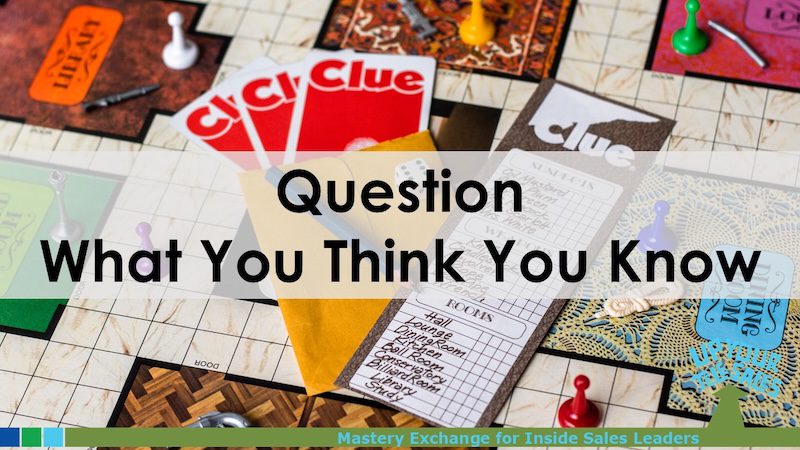
If you’ve ever played Clue, you know how easy it is to develop a theory before you have all the information.
You start collecting clues, eliminating possibilities, and pretty soon you have a good idea of what happened. Then another card gets revealed and what you thought you knew changes.
Experience as an inside sales leader can work a little like that. You’ve heard the excuses, seen deals stall, and watched salespeople struggle. Eventually, you start recognizing patterns, and that pattern recognition is valuable. It helps you spot things faster and gives you a pretty good idea of what might be going on.
The danger is when your pretty good idea becomes your conclusion.
Diagnose Before You React
A salesperson isn’t making enough calls, and you have a theory about why. Another has plenty of opportunities in the pipeline, but nothing is closing, and you have a theory about that too. Someone keeps coming to you with the same problem, and you’ve seen this pattern enough times that you’re fairly certain you know what’s going on.
You might be right.
Experience gives you those theories because you’ve seen similar situations before. The next step is to gather enough information to find out whether this situation really is what you think it is.
This is one of the reasons I use Can’t, Won’t, Don’t Know How as a diagnostic tool.
- Is there something preventing the salesperson from doing what’s expected?
- Are they choosing not to do it?
- Do they lack the knowledge or skill to do it successfully?
What you see on the surface can look remarkably similar in all three situations. A salesperson isn’t doing what you expect them to do. Yet what you do as their leader depends on what’s actually causing the behavior.
Get Curious Before You Get Helpful
Experience makes it tempting to move quickly into solution mode. We recognize the problem, remember how we’ve solved something similar before, and want to help. That ability is one of the benefits of having been around the leadership block a few times.
Before you offer the answer, gather a little more evidence. Ask what happened and what they tried. Find out where they got stuck, what they expected to happen, and what happened instead. Ask what they believe is getting in their way.
Their answers may confirm exactly what you suspected. They may also reveal something you hadn’t considered, which is why curiosity remains so important even when you’re fairly certain you already know the answer.
Put It Into Practice
This week, pay attention to the moments when you find yourself thinking, I know what’s going on here.
Instead of treating that thought as your conclusion, use it as your cue to get curious. Ask another question, look for another piece of evidence, and test your theory before deciding what leadership response makes sense.
You don’t need to ignore your experience or pretend you haven’t seen similar situations before. Your experience is what helps you recognize the clues in the first place.
Your experience helps you recognize the clues. Curiosity helps you make the right diagnosis.
Still curious along with you,
Lynn
P.S. Know another experienced inside sales leader who might appreciate a few more clues before reaching a conclusion? Feel free to forward this newsletter.