
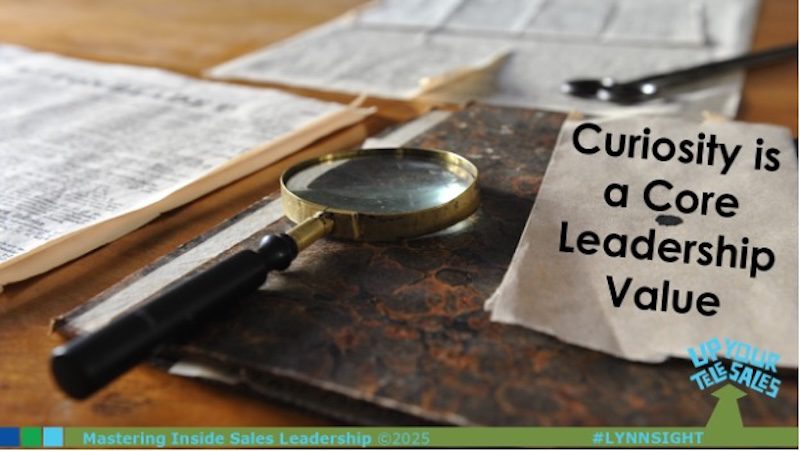
I joked recently that one of my leadership strategies is: “Google it.”
No really, it is. I’ll search the challenge, study a few perspectives, run it through my own experience, and adapt what makes sense. You can absolutely use AI tools the same way.
The interesting part, to me, is how uncomfortable some leaders seemed with the idea of needing to look something up at all. I think that reveals something bigger happening inside sales leadership right now.
Too many leaders quietly believe they are supposed to already know everything.
Inside sales environments unintentionally reinforce that pressure.
Your team asks questions all day.
Leadership wants direction.
Forecasts need explaining.
Performance issues need fixing.
Processes need improving.
Customers change.
Markets shift.
Technology evolves.
Messaging changes.
At some point, many inside sales leaders quietly start believing: “If I don’t know, maybe I’m behind.”
That mindset becomes dangerous very quickly. Leadership curiosity is far more valuable than leadership ego. Leaders should never stop pursuing expertise.
The strongest inside sales leaders I know are not the ones pretending to have every answer immediately.
They are the ones willing to:
- research
- explore
- adapt
- ask better questions
- challenge their own assumptions
- and keep learning in real time
Inside sales changes constantly, which is why the strongest sales cultures are built around learning.
That doesn’t mean leaders chase every trend or blindly apply every idea they read online.
Inside sales leadership still requires judgment and your team does need consistency, rather than whiplash from every day revolving around the new thing or the next thing.
But refusing to explore because you think leaders are supposed to already know everything?
That creates stagnation very quickly.
Looking something up does not weaken your credibility. There’s actually a tremendous amount of confidence in saying:
“We will look into that together.”
“I want to think about that more.”
“Let’s research a few approaches.”
“I’ve seen different perspectives on this.”
Intellectual honesty builds trust inside teams much faster than forced certainty (with customers and prospects as well, come to think of it).
One of the biggest shifts happening in inside sales right now is the speed of accessible information.
A leader no longer has to figure everything out alone.
You can:
- search real-world examples
- study different frameworks
- explore buyer trends
- review sales conversations
- analyze messaging
- test AI-supported workflows
- compare perspectives quickly
- join The Mastery Exchange for Inside Sales Leaders mastermind
That’s an advantage if leaders use it wisely.
Good leaders continue to learn!
This applies to salespeople too. Some salespeople struggle because they spend more time protecting their image than improving their skill set. They avoid:
- asking questions
- researching objections
- studying buyer behavior
- reviewing calls
- learning new approaches
- experimenting with messaging
You may have noticed, the best salespeople are often the most curious people on the team.
Inside sales is not a profession where people can rely entirely on what worked five years ago. The environment changes too quickly.
Curiosity keeps leaders flexible.
Curiosity keeps teams improving.
Curiosity prevents stagnation.
And perhaps most importantly: curiosity creates an environment for the rest of the team to keep learning too.
When leaders model thoughtful curiosity, teams become more adaptive and resilient.
Resilience is critical for inside sales success. The environment continues to move too quickly for rigid leadership to survive for very long.
I’m here to remind you, you’ll lose credibility when your ego becomes more important than your growth. The strongest inside sales leaders are ones committed to learning fast enough to keep helping the team grow.
Keep evolving,
Lynn