
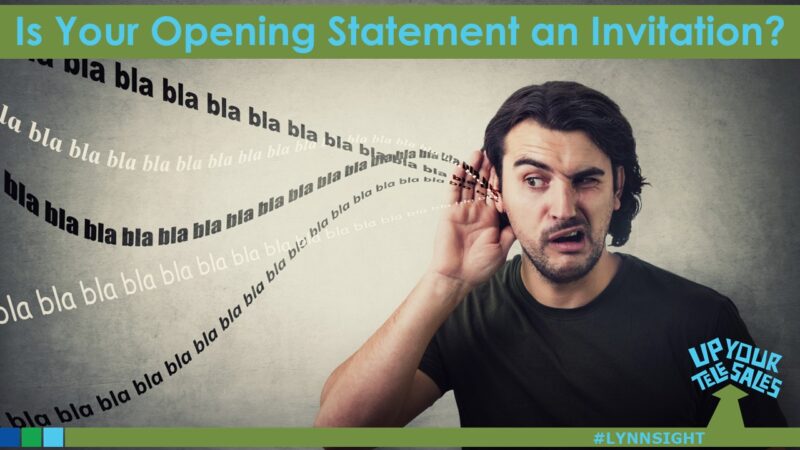
Inside salespeople spend a lot of time trying to perfect their message.
They research prospects. They study the company. They review LinkedIn profiles. They build call plans.
Then they pick up the phone and start with:
“Hi, this is Sarah from ABC Company. How are you today?”
And just like that, the opportunity to have a conversation slips away.
The truth is that most opening statements fail because they’re focused on the wrong objective.
The purpose of an opening statement is to earn the right to have a conversation.
Today’s Buyers Are Overwhelmed
Their inboxes are flooded with automated emails. LinkedIn messages arrive by the dozen. Voicemails stack up faster than they can return them.
No one needs (or wants) another sales pitch.
You need to give them a reason to stop what they’re doing and pay attention.
That’s why your opening statement matters more than ever.
You have only a few seconds to answer the prospect’s unspoken question:
Why should I keep listening?
If your opening doesn’t answer that question, nothing else matters.
Stop Leading With You
Most opening statements focus on the salesperson.
- “My company…”
- “Our solution…”
- “We help organizations…”
Your prospect doesn’t care yet!!! They don’t know you. They don’t trust you. And they certainly aren’t waiting for a stranger to explain products and services.
Instead, focus on something that matters to them.
Compare these two openings:
Product-Centered Opening
“Hi John, this is Mike with ABC Software. We help manufacturers improve operational efficiency and reduce costs.”
Problem-Centered Opening
“John, many manufacturing leaders I’ve spoken with recently are trying to reduce production delays without increasing labor costs. I was curious if that’s something you’re seeing as well.”
One sounds like a commercial.
The other sounds like the beginning of a business conversation.
The Three Elements of an Effective Opening
Great opening statements are surprisingly simple.
They usually contain three things.
1st Relevance
Show that there is a reason for your call beyond random prospecting. Reference a challenge, trend, opportunity, or business issue that is meaningful to the prospect.
People pay attention when the conversation feels connected to their world.
2nd Curiosity
The goal is to create enough interest to continue. Curiosity opens doors, trying to pitch without knowing anything closes them.
Ask questions that encourage prospects to think rather than defend themselves.
3rd Confidence
With confidence, you sound like someone who believes the conversation is worth having.
You don’t apologize for calling. You don’t rush. You don’t sound like you’re reading a script.
You are a professional bringing value.
The Biggest Mistake Inside Salespeople Make
Many salespeople try to accomplish too much in the first thirty seconds.
They attempt to explain the company.
Describe the solution.
Share customer success stories.
Differentiate themselves from competitors.
And ask for a meeting.
All before the prospect has decided whether to stay on the call.
The opening statement is where you earn permission to explore.
You aren’t trying to sell.
You’re trying to determine whether there’s a business reason to continue the conversation.
- If the prospect doesn’t believe you’re relevant, they won’t care about your solution.
- If they don’t trust you, they won’t care about your customer stories.
- If they haven’t identified a problem worth discussing, they won’t care about your pitch.
The goal is simple: Move from interruption to engagement.
Once you’ve done that, the sales process can begin.
What Buyers Really Want
People can look up information for themselves. What they’re looking for is insight and perspective. They’re looking for someone who understands their challenges and can help them think differently.
The best opening statements position you as a resource for exactly that!
When your opening demonstrates understanding, prospects become more willing to engage.
Safety tip: this doesn’t mean they’re ready to buy!
A great opening makes them curious enough to continue the conversation.
And curiosity is where every successful sales conversation begins.